
There is a particular feeling that comes with walking up a gangway onto an expedition vessel, and it is not quite the same as boarding any other ship. Corridors full of people trying to find their cabins, introductions being made in doorways, meeting your cabin mates for the first time and working out where everything is or where it is going to go. Everywhere that particular mix of barely contained excitement and mild bewilderment that comes from finding yourself amongst strangers, all of whom share exactly the same look: the look of someone who still cannot quite believe they are actually here. And why would you? The destinations on the itinerary — the Falkland Islands, South Georgia, South Orkney, Elephant Island, Deception Island, Antarctica and the polar circle — are not places you take for granted and for many, this expedition has been a long time in the making.

Once the initial flurry had settled, there was also the pleasing realisation that the ship is both smaller and more purposeful than you might expect, with a patient crew fielding what must have been the same questions on a loop without once appearing to mind. It also helped that the bar was stocked with excellent local beers, wine and gin, and a cocktail of the day that nobody was ignoring. An expedition ship does not have to mean roughing it. It just means that what lies outside the windows is considerably more interesting than what lies inside.
Hondius, operated by Oceanwide Expeditions, is a purpose-built polar expedition cruise vessel: ice-strengthened, relatively compact, and designed to go to places that most ships have no business being. She carries expedition cruise passengers south with the kind of no-nonsense competence the destination demands. Amongst those passengers on this voyage was our team: twenty-two women, researchers and scientists from a range of disciplines, using Hondius as a Ship of Opportunity to carry out our various research projects in some of the most remote waters on the planet. A Ship of Opportunity is exactly what it sounds like: a vessel that is going somewhere useful anyway, and that carries scientists along to make the most of the passage. It is a pragmatic, cost-effective way of doing science in places where getting there is half the battle and dedicated research vessels are expensive and scarce. For us, it meant that the ship’s expedition programme and our research objectives ran in parallel throughout the voyage, which made for a full schedule and an excellent trip.
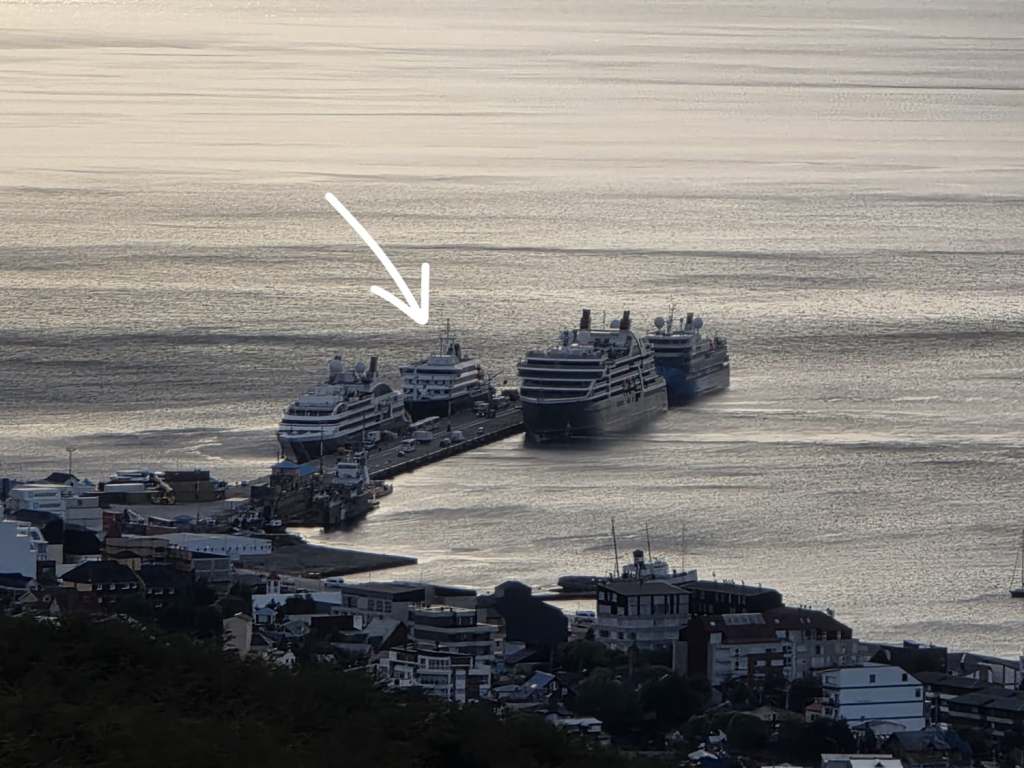
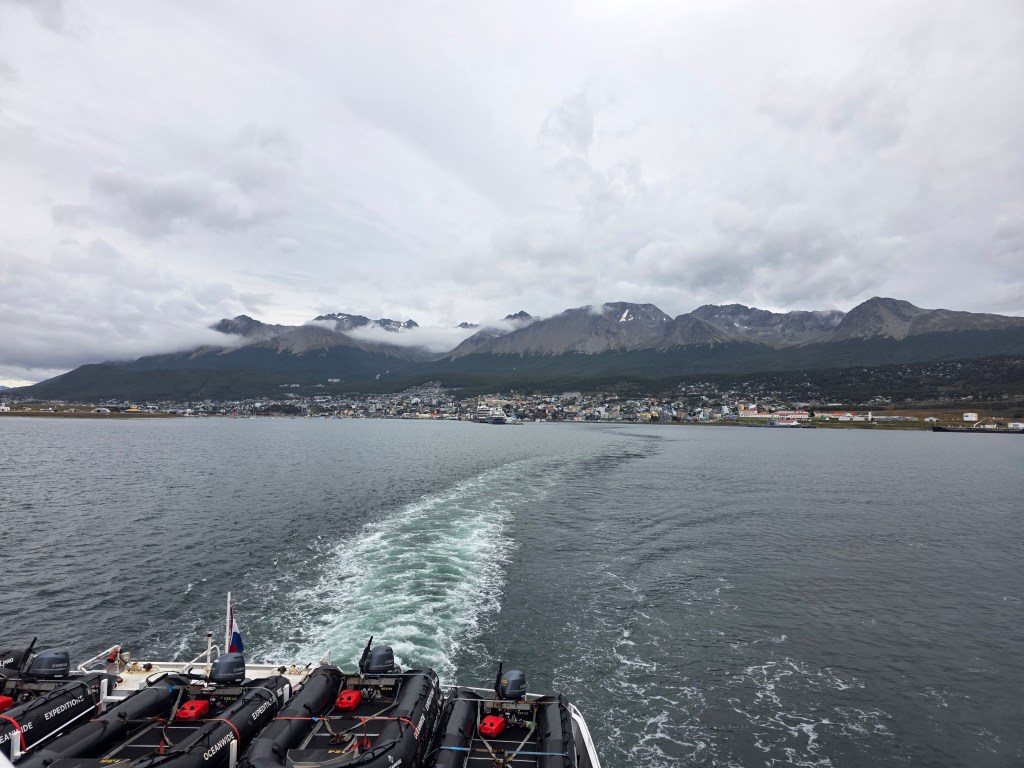
Before we sailed, the mandatory safety briefing and muster drill did what it needed to do: life jackets located, muster stations found, emergency procedures absorbed. Sensible stuff, efficiently done. And then, almost before we knew it, Hondius cast off and nosed out into the Beagle Channel, and Ushuaia began to slide away behind us.
The Beagle Channel: An Unexpectedly Spectacular Warm-Up Act
Any notion that the wildlife encounters would begin once we reached the Falkland Islands or Antarctica was immediately and comprehensively dismantled by the Beagle Channel. Within a remarkably short time of leaving Ushuaia, magellanic penguins were bobbing contentedly on the glassy water, entirely unbothered by the ship easing past them. Huge rafts of sooty shearwaters lifted en masse as we approached, rising in great dark clouds before scattering in all directions. Southern giant petrels and black-browed albatrosses were already winging past with that effortless authority that would become a defining feature of the days ahead. Two groups of Peale’s dolphins appeared briefly alongside the ship, leaping cleanly in the calm water, and then they were gone. And guess who didn’t have their camera with them…..
With the wildlife still fresh in our eyes, the evening began with the welcome talk: a glass of champagne and our first proper meeting with the expedition team who would be guiding us south. And then the light began to fade, and the sei whales appeared.
A group of around twenty, feeding in the channel as the evening came in. We were supposed to be in a planning meeting. The planning meeting did not stand a chance. What followed was a gloriously undignified scramble for the deck, accompanied by a considerable amount of squealing, as twenty sei whales went about their business in the fading light while twenty-two scientists completely lost their composure. This, it turned out, was a perfectly accurate preview of pretty much every cetacean sighting to come from the decks of Hondius.
Sei whales are the third largest whale species on Earth, and among the least well understood of the great whales. They are fast, unpredictable, and notoriously difficult to study, which has historically made population assessments challenging. Seeing a group of this size feeding together in the Beagle Channel was, by any measure, exceptional.
The atmosphere aboard that evening was warm and full of anticipation, but underneath the excitement, at least for some of us, ran a quieter current of unease.
HPAI: The Shadow Over the Season
Highly Pathogenic Avian Influenza (HPAI) arrived in the Falkland Islands in October 2023, and what followed has been devastating at a speed and scale that is frankly terrifying. The disease spread rapidly to South Georgia, where research led by the British Antarctic Survey has since recorded a 47% decline in breeding female elephant seals between 2022 and 2024, with pup mortality exceeding 90% at some colonies. Antarctic fur seals have been badly hit too, the virus confirmed in populations across the region. By early 2024, HPAI H5N1 had been confirmed south of 60°S on the Antarctic mainland for the first time, detected in skuas at James Ross Island on the Antarctic Peninsula. By the 2024/25 austral summer, H5N1 had been confirmed in eight species across the South Shetland Islands and Antarctic Peninsula, including Antarctic fur seals, southern elephant seals, kelp gulls, Antarctic terns and multiple seabird species. Most recently, crabeater seals, one of Antarctica’s most abundant ice-dependent species, have been confirmed infected for the first time. Since 2022, H5N1 has killed at least 600,000 wild birds and 50,000 mammals across South America alone. The virus is moving south, and it is not slowing down.
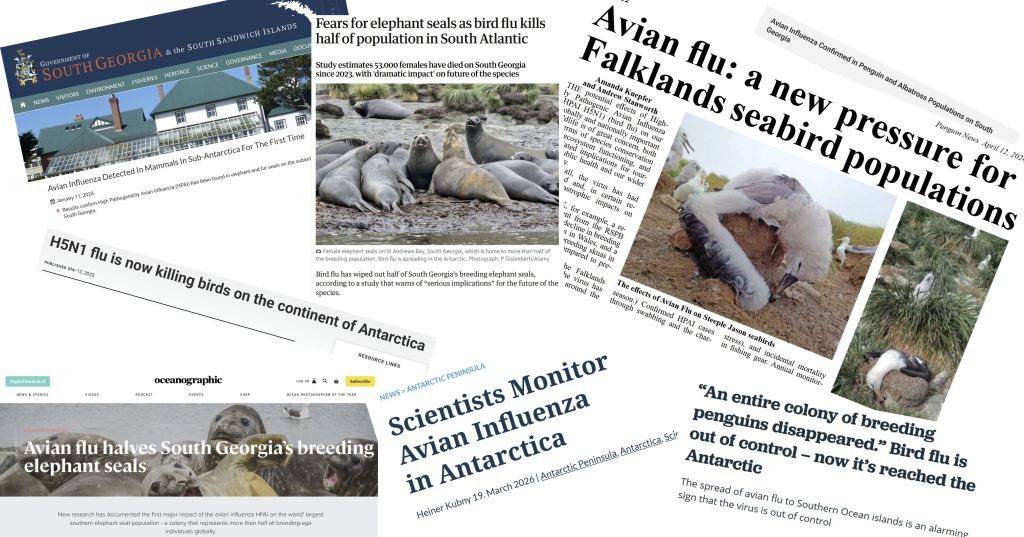
What makes this particularly alarming is the rate at which HPAI has crossed from birds into marine mammals. In Europe, where H5N1 has circulated in wild bird populations for years, this kind of spillover into marine mammal populations at scale simply has not happened (yet). In South America and now the Southern Ocean, it is happening rapidly and repeatedly, with evidence emerging that the virus is actively adapting to spread more efficiently between mammalian hosts. The implications of that for already pressured Southern Ocean populations are deeply concerning.
As someone who manages the Strandings Initiative for the International Whaling Commission (IWC), the intergovernmental body responsible for the conservation and management of whales, this is not an abstract concern. Strandings data provides one of our most important windows into the health of cetacean populations, and emerging infectious disease is increasingly part of that picture. Colleagues working on IWC’s Strandings Expert Panel have been on the frontline of the South American outbreaks, responding to HPAI-related mortality events in cetaceans and working to understand how the virus is moving through populations that have never encountered it before. HPAI represents exactly the kind of fast-moving, cross-species threat that makes that work so urgent and, at times, so sobering.
All of which made the briefings that followed feel less like routine procedure and more like genuine necessity. If you board an Antarctic expedition vessel expecting a gentle introduction, you may wish to recalibrate your expectations. The briefings came thick and fast: IAATO protocols, Zodiac safety, wildlife guidelines, biosecurity procedures, the dos and do-not-under-any-circumstances-dos of visiting one of the most protected environments on the planet. The International Association of Antarctica Tour Operators sets strict regulations governing visitor behaviour, and every single one of those briefings exists for good reason. Antarctica does not forgive carelessness, and the ecosystems we were heading towards have enough pressure on them already without avoidable human impact adding to the burden. For those of us who had just spent an hour absorbing the scale of the HPAI situation, the boot washing stations and disinfection protocols carried a weight that went well beyond routine compliance.
I was genuinely uncertain about what we would find when we reached the Falkland Islands. The reports from earlier in the season had not made for easy reading. That uncertainty was something several of us carried quietly onto the deck when we were finally released into the South Atlantic air.
Into the South Atlantic: Sea Legs and Albatrosses
By the time we had a decent stretch of time on deck, the ship was well into open water, the wind had found us, and the South Atlantic was making its presence known. Force 6 to 7, seas running at two to three metres: not dramatic by the standards of what lay further south, but enough to make the ship move with purpose and enough to separate those who had found their sea legs from those still negotiating. I am glad to report that mine were exactly where I had left them. Now, I am aware that “only a Force 6” are words not universally well received, and I say them with full respect for those having a rather more horizontal afternoon than I was. Having spent several years working at sea on ships of all shapes and sizes, from small inshore survey boats to large research vessels, car ferries and cruise ships, I have had ample opportunity to make my peace with a moving deck, and standing there with salt on my face and the wind doing its worst, I felt entirely, happily at home. The South Atlantic does not do subtlety, and I would not have it any other way. From the moment I stepped on deck — and if I am honest, from the windows of the briefing rooms long before that — it was immediately apparent that the seabirds were simply omnipresent. A constant, shifting escort of wings off the stern and around the bow, never quite the same twice, never entirely absent. For someone on their fifth visit to these waters, it felt less like a wildlife encounter and more like catching up with old friends. Familiar, joyful, and every bit as wonderful as the first time. Even if some of the more challenging species had me quietly dusting off identification skills that had grown a little rusty on land.
The Albatrosses
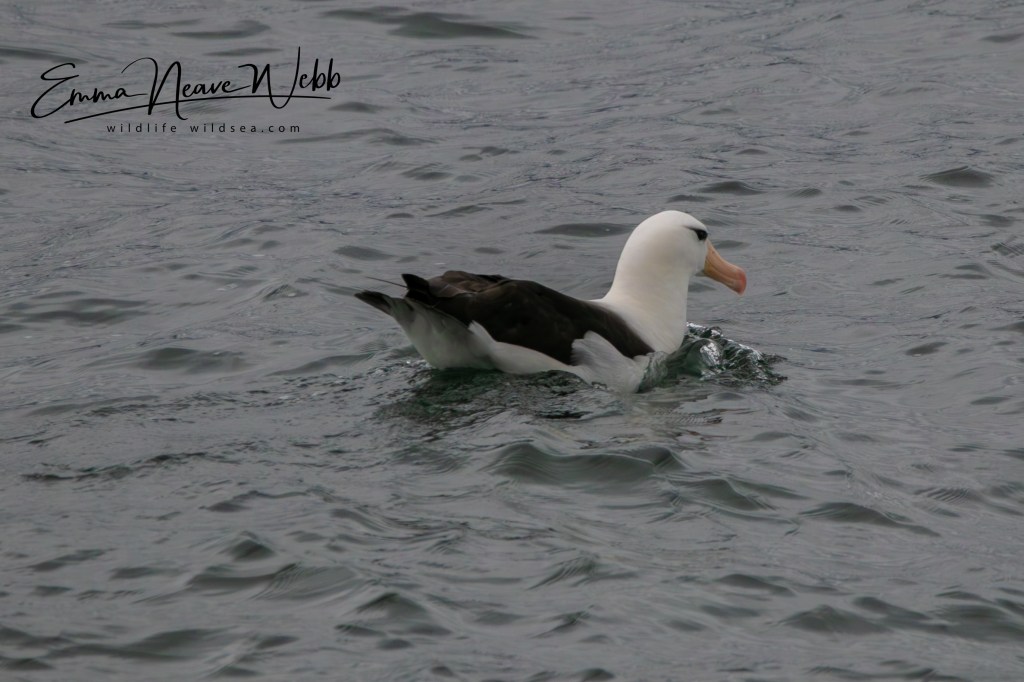
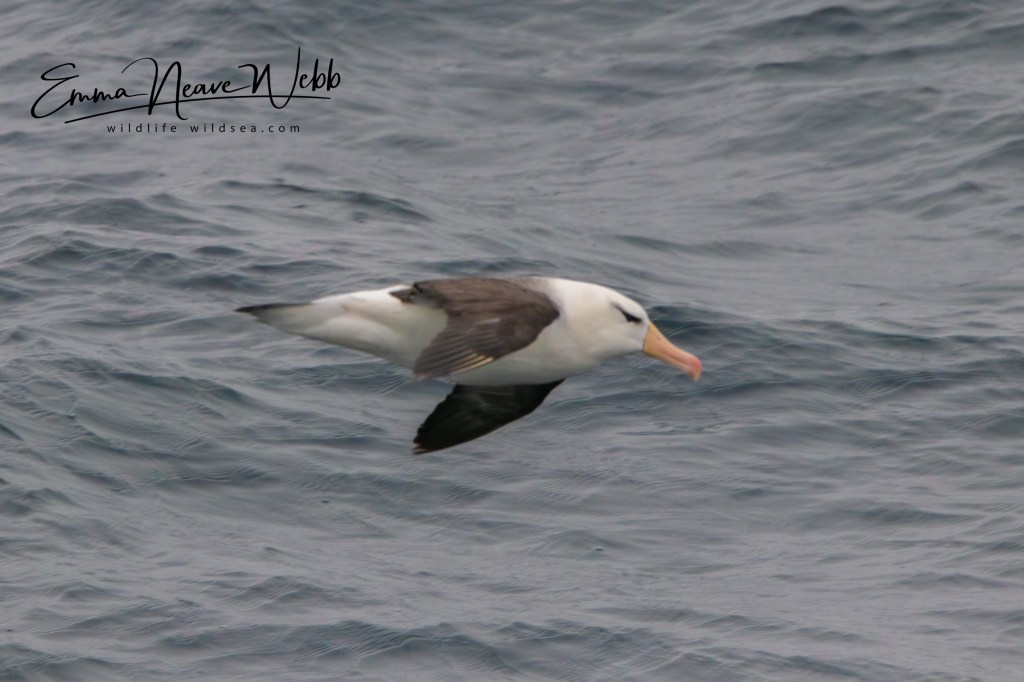
Black-browed albatrosses appeared almost immediately, quartering the wake with that long-winged, banking glide that makes every other form of flight look over-complicated. They are the most numerous of the great albatrosses in these waters, and the most likely to escort a southbound vessel. With a wingspan of up to 2.4 metres and striking yellow-orange bills framed by the dark eyebrow marking that gives them their name, they are immediately identifiable and endlessly watchable. They breed colonially, predominantly on the Falkland Islands (we would hopefully be visiting a colony there) and South Georgia, in enormous aggregations that number in the hundreds of thousands of pairs. They are also, like all albatrosses, under sustained pressure from longline fishing bycatch, a problem that conservation organisations including BirdLife International’s Albatross Task Force have been working to address for decades.
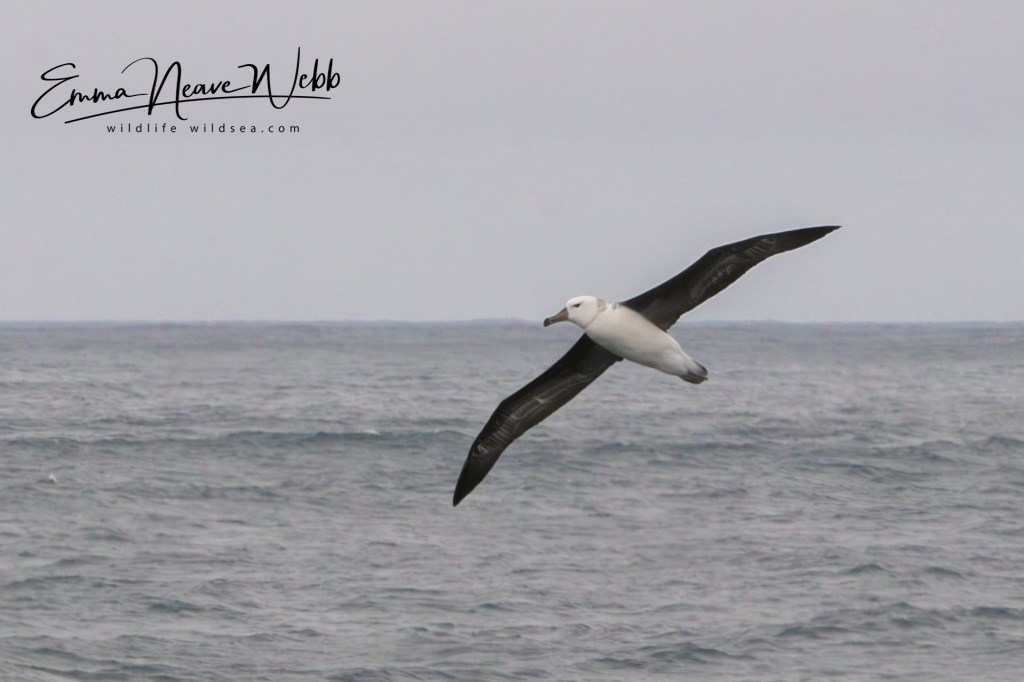
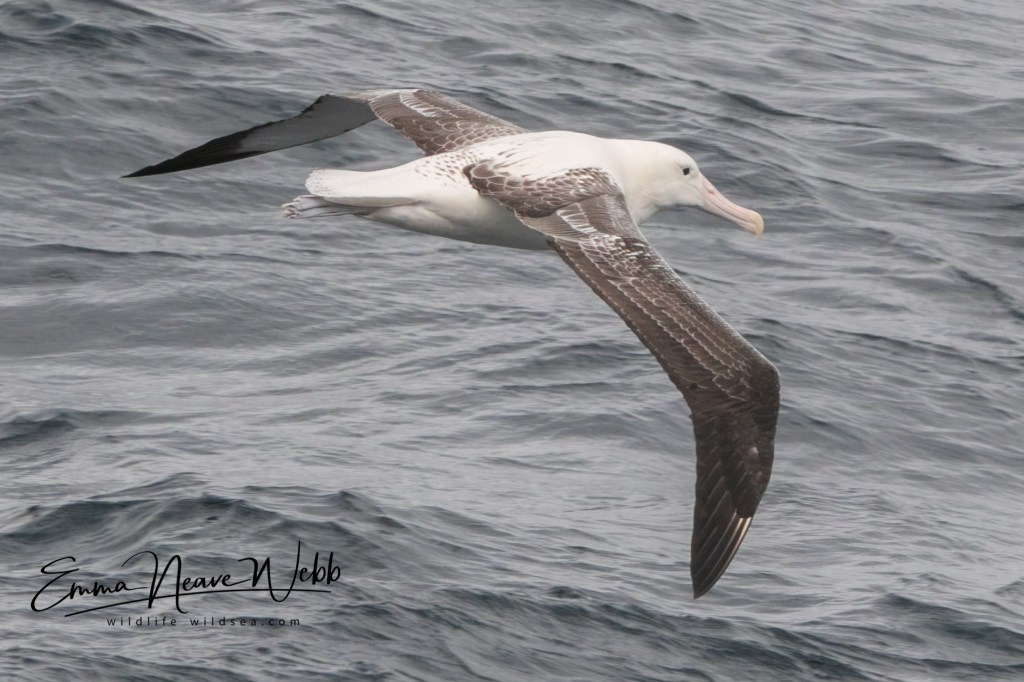
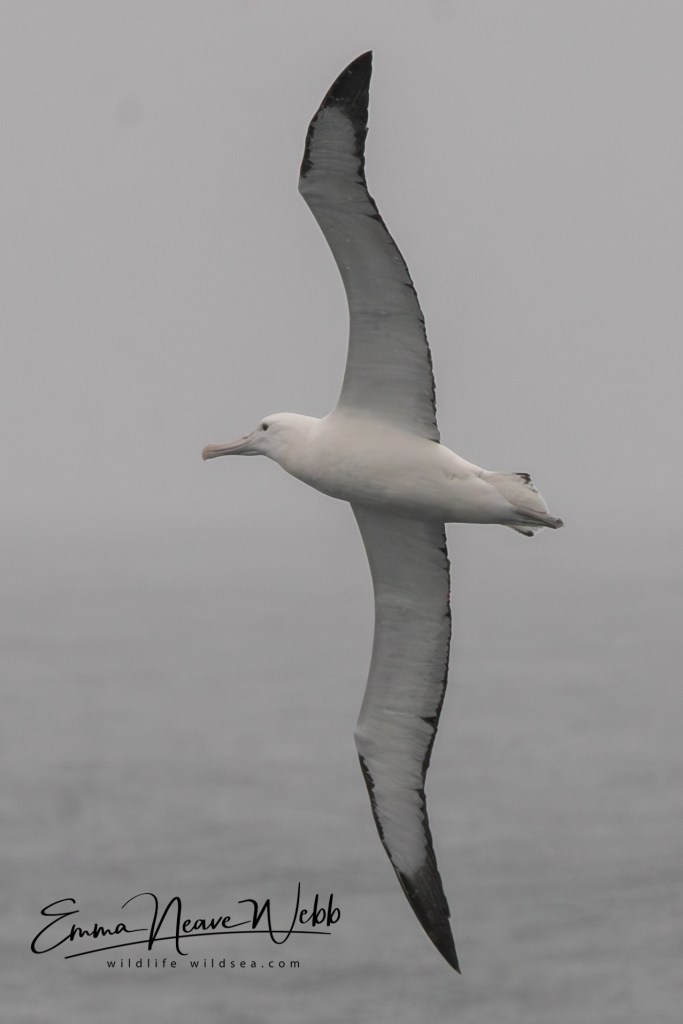
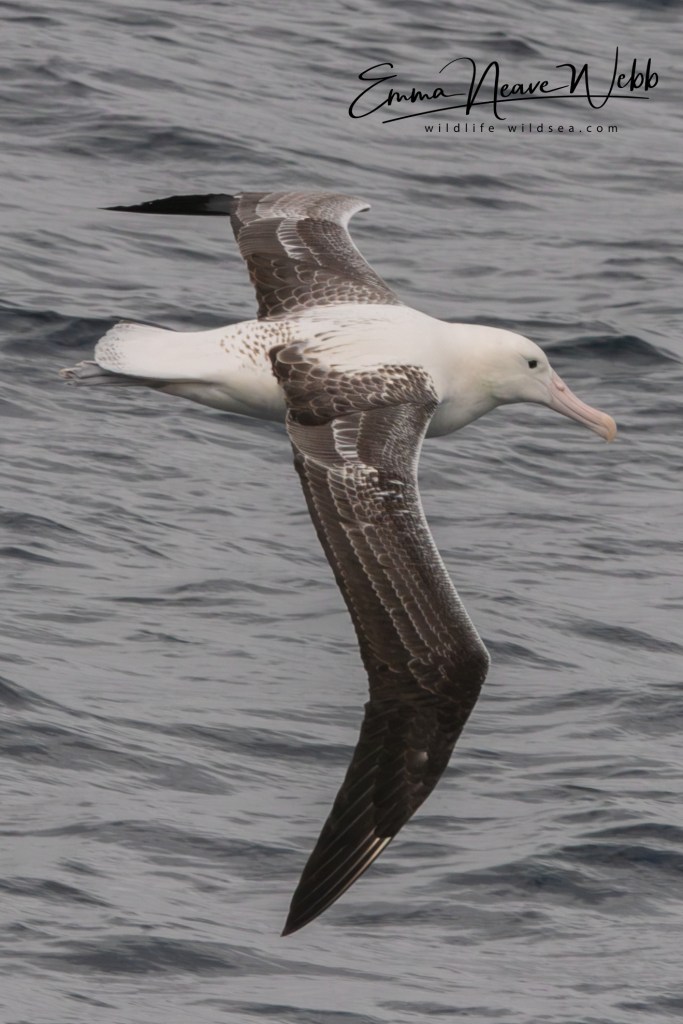
The royal albatrosses required more careful attention. These are the giants: a southern royal albatross carries a wingspan of up to 3.5 metres, making it one of the largest flying birds on the planet. They are predominantly white-bodied with black wingtips, and at close range the sheer scale of them is arresting. We had predominantly southern royals alongside us, but at least one northern royal was confirmed from photographs, identified by the subtle differences in wing pattern that reward the kind of sustained, careful observation that rough weather and a moving deck make simultaneously essential and inconvenient. Both species breed on subantarctic islands: the southern royal almost exclusively on Campbell Island and the Auckland Islands, the northern royal primarily on the Chatham Islands. They are long-lived, slow-breeding birds that do not reach sexual maturity for a decade or more, which makes population recovery from any human-caused mortality painfully slow.
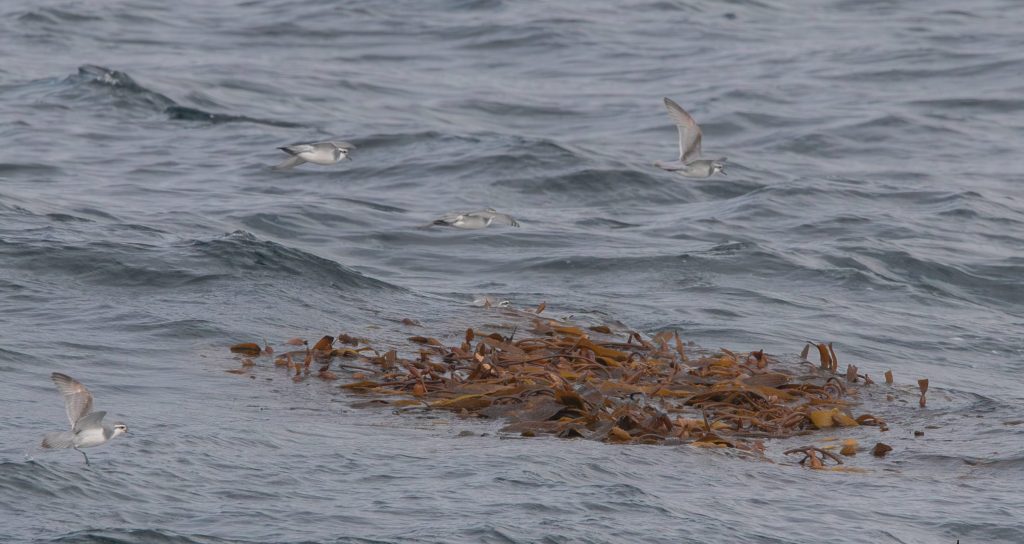
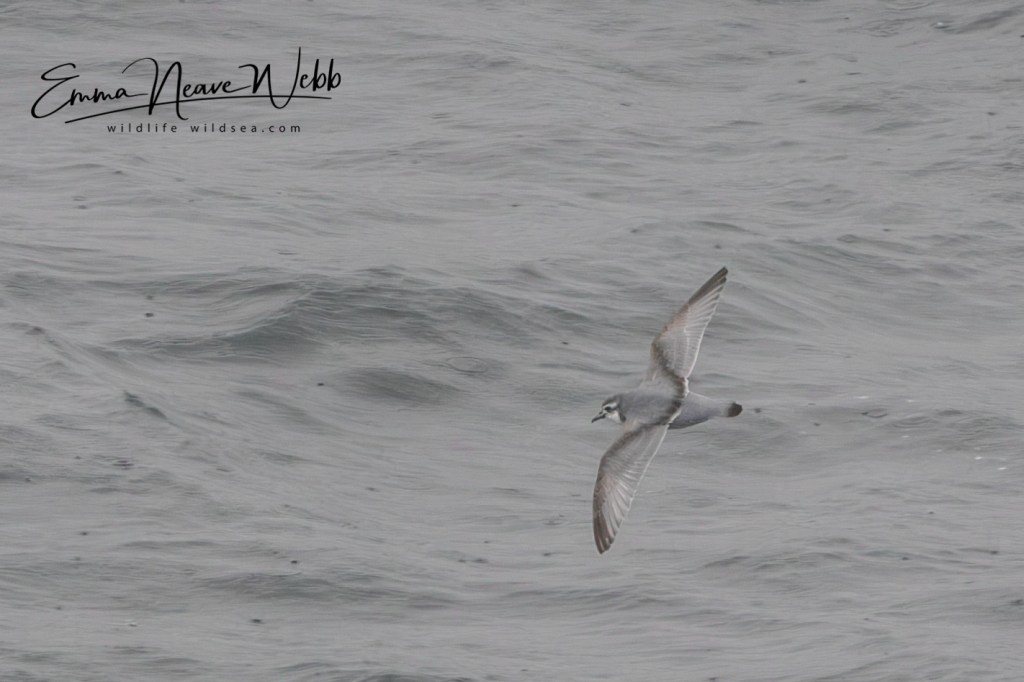
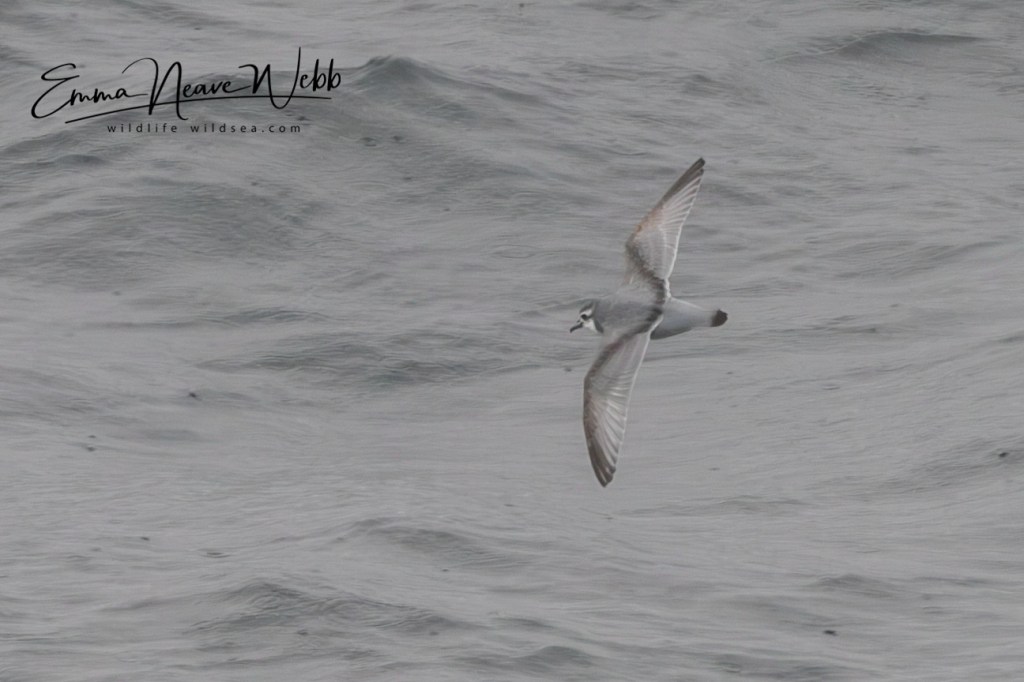
The prions deserve a mention too, not because they are the most spectacular birds in these waters, but because they are among the most numerous, and their biology is quietly remarkable. Small, blue-grey and fast-moving, they are built for a life at sea, rarely coming to land except to breed. Identifying them to species level is, frankly, a humbling experience. The various prion species are notoriously similar in appearance, and one of the expedition team delivered what I found to be both a reassuring and slightly alarming piece of information: that even with a bird in the hand, species identification can sometimes be impossible. In the field, in a two to three metre swell, from a moving deck, the chances of a confident call are slim at best. Photographing them is an exercise in optimism and patience in roughly equal measure: by the time the camera has found a small, fast-moving, blue-grey bird against a grey sea in a grey sky, it has already gone. The majority of the birds we were seeing were presumed to be slender-billed prions, a reasonable assumption given our trajectory towards the Falkland Islands, where New Island holds one of the largest slender-billed prion colonies in the world. Their bills are laterally expanded, adapted for filter-feeding on the copepods and small crustaceans that make up the dense zooplankton of the South Atlantic. In good light, in the right conditions, you might just pick out the subtle facial markings and bill shape that separate them from their almost identical relatives. In a two to three metre swell, you mostly just appreciate that there are a lot of them and they are extremely good at not being hit by ships.
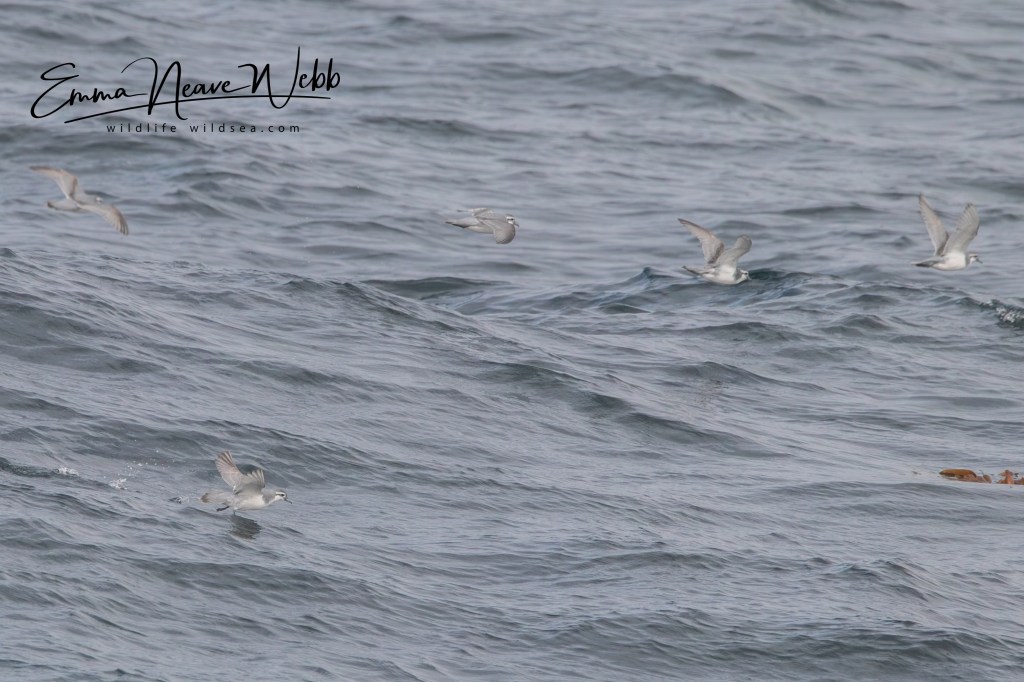
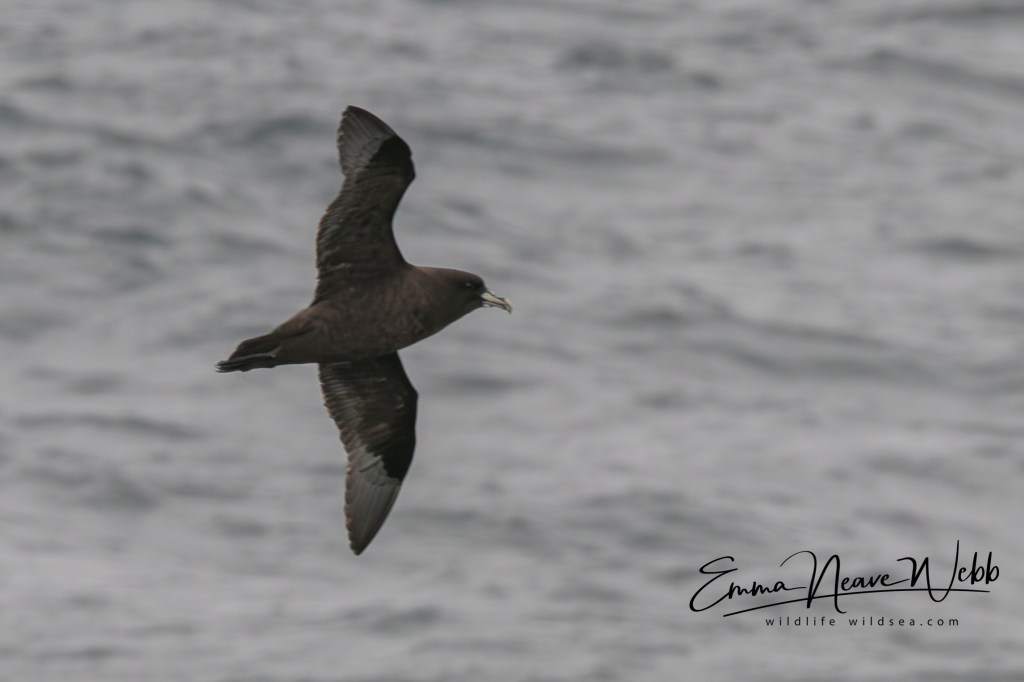
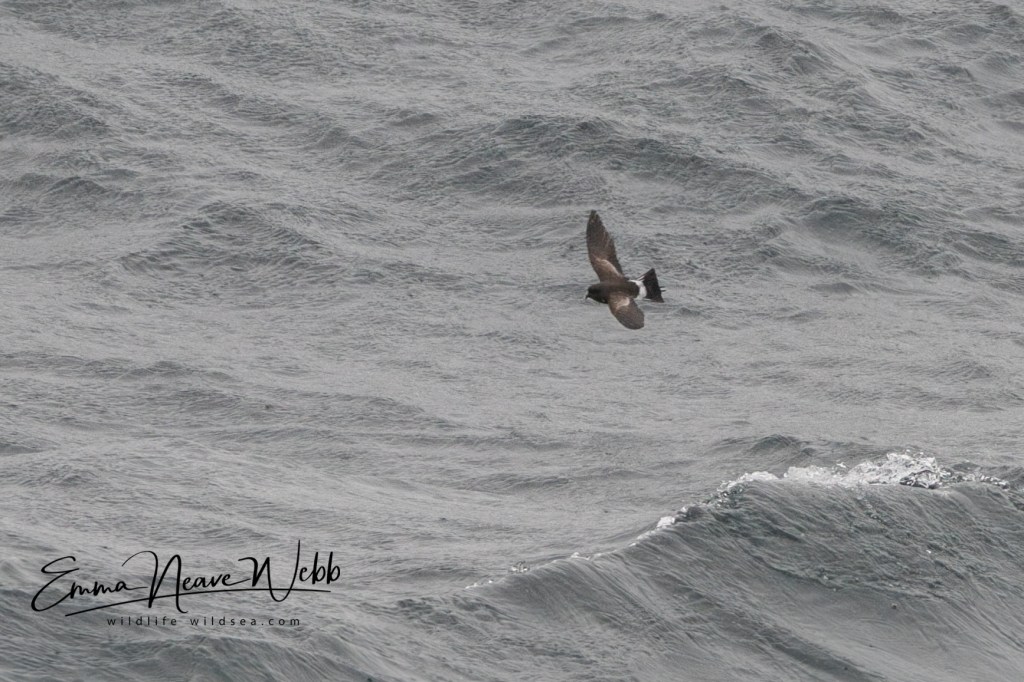
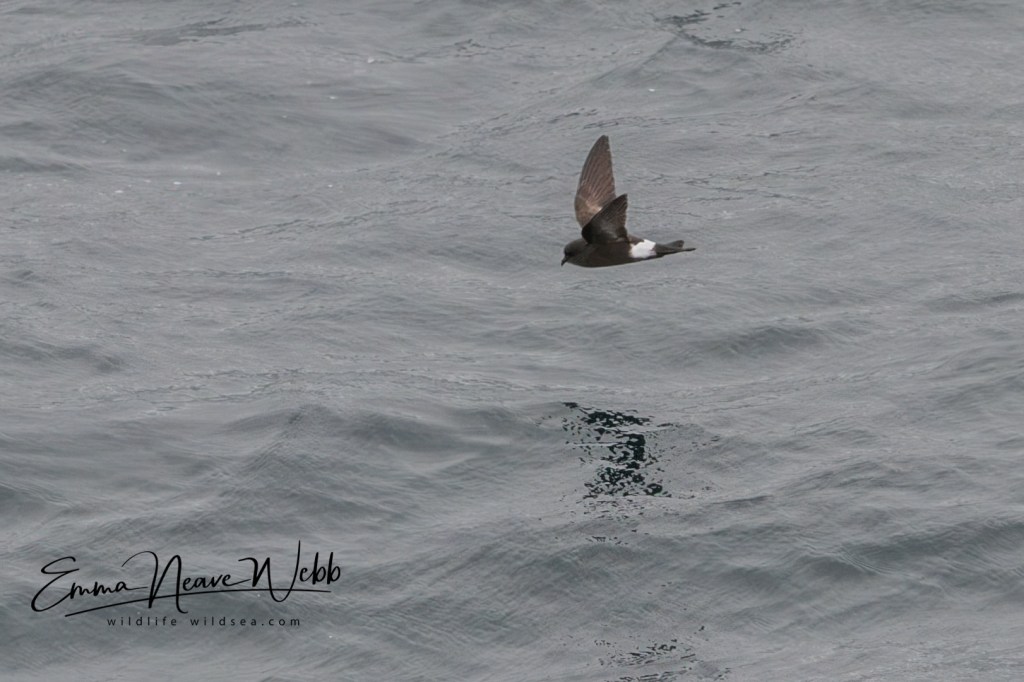
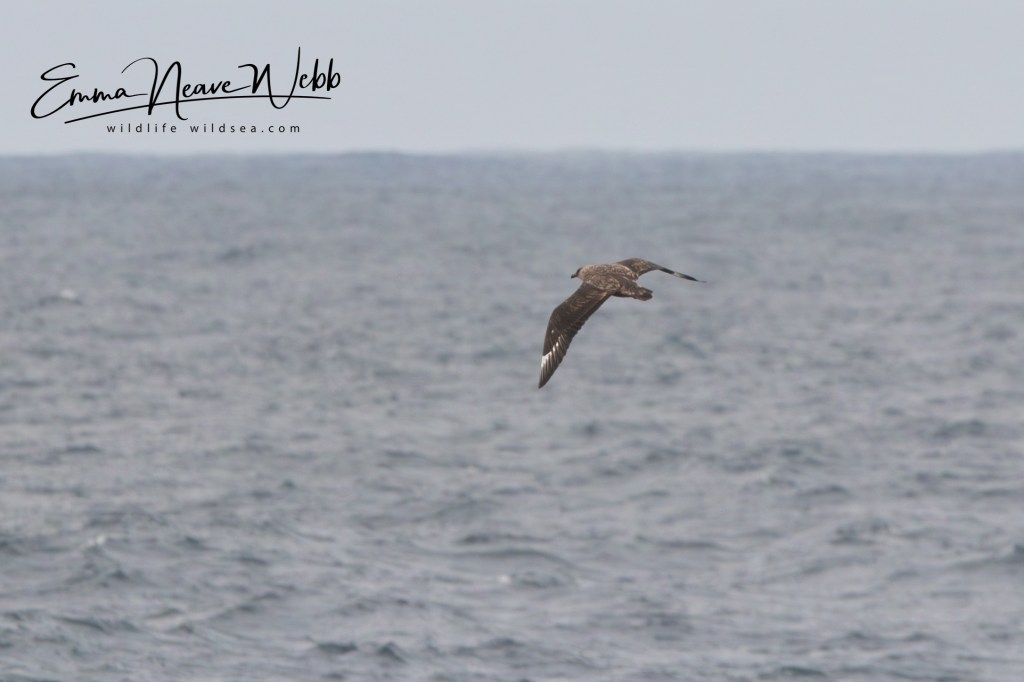
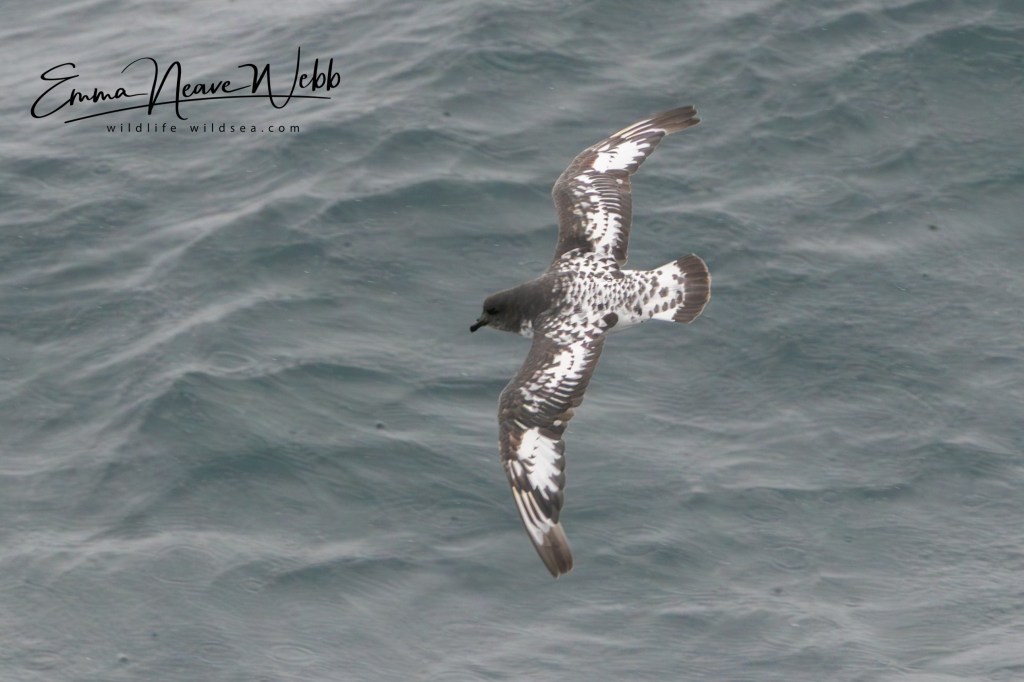
If the prions tested the patience of the camera, the Wilson’s storm petrels pushed it to its limits. Tiny, dark and utterly relentless in their energy, they danced above the wave crests in that extraordinary pattering motion that gives the storm petrels their name, an echo of St Peter walking on water. Beautiful, captivating, and almost completely impossible to photograph well. I tried and emerged with a handful of images that I am choosing to describe as atmospheric rather than blurry. You can decide whether you agree. The skua at least had the decency to provide a departing shot as it powered purposefully past, clearly on a very specific mission towards the Falkland Islands. Two cape or pintado petrels made a brief flypast too, their unmistakeable black and white check pattern a welcome splash of contrast against the grey.
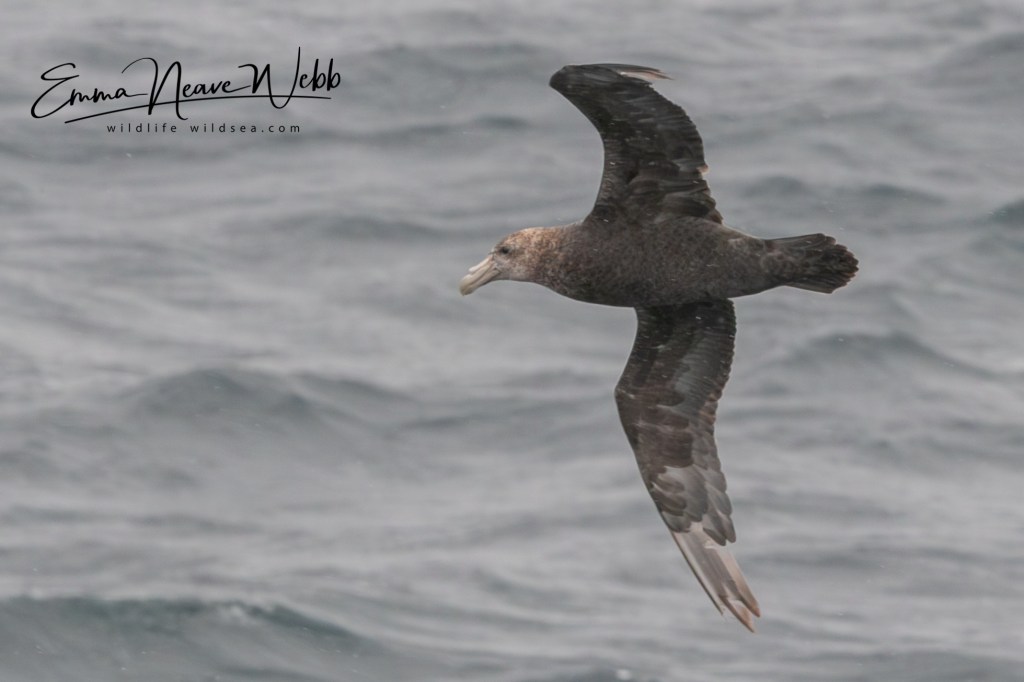
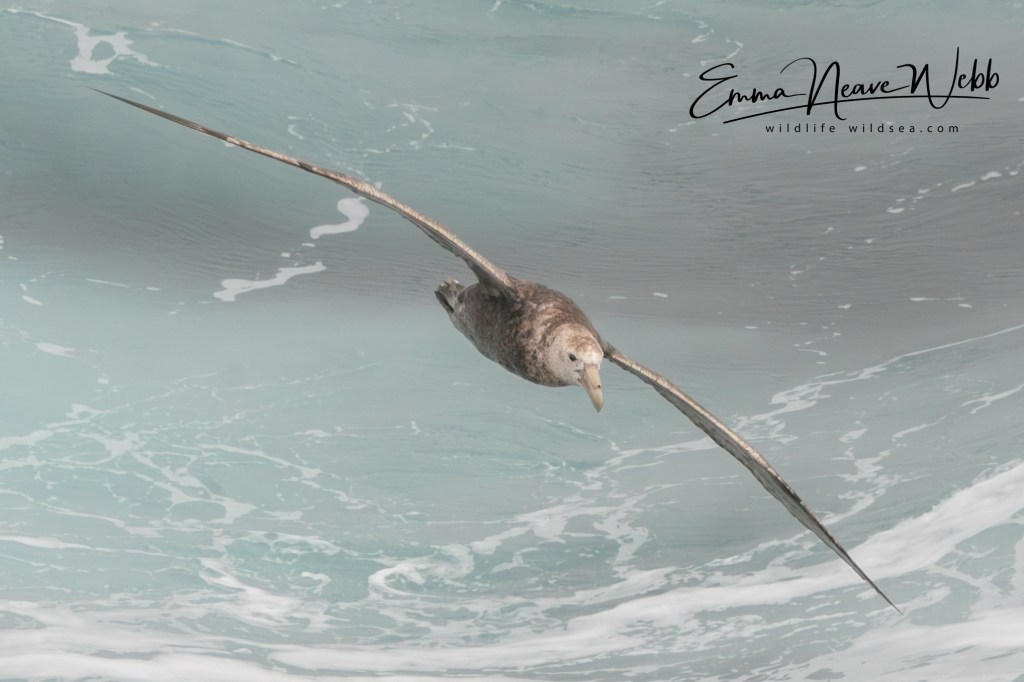
The southern giant petrels were the undisputed stars of the afternoon’s photography session. Ever present, circling the ship with that effortless, heavy-winged authority, they are not mild. They are large, calculating and faintly sinister, with the air of a bird that is permanently planning something and simply waiting for the right moment to act on it. That extraordinary hooked bill and those pale, watching eyes do not suggest a creature that is merely passing the time. They suggest a creature that has identified an opportunity and is working out the logistics. Against the turquoise and white of the wake, they made for extraordinary portraits. These are not predators to be messed with.
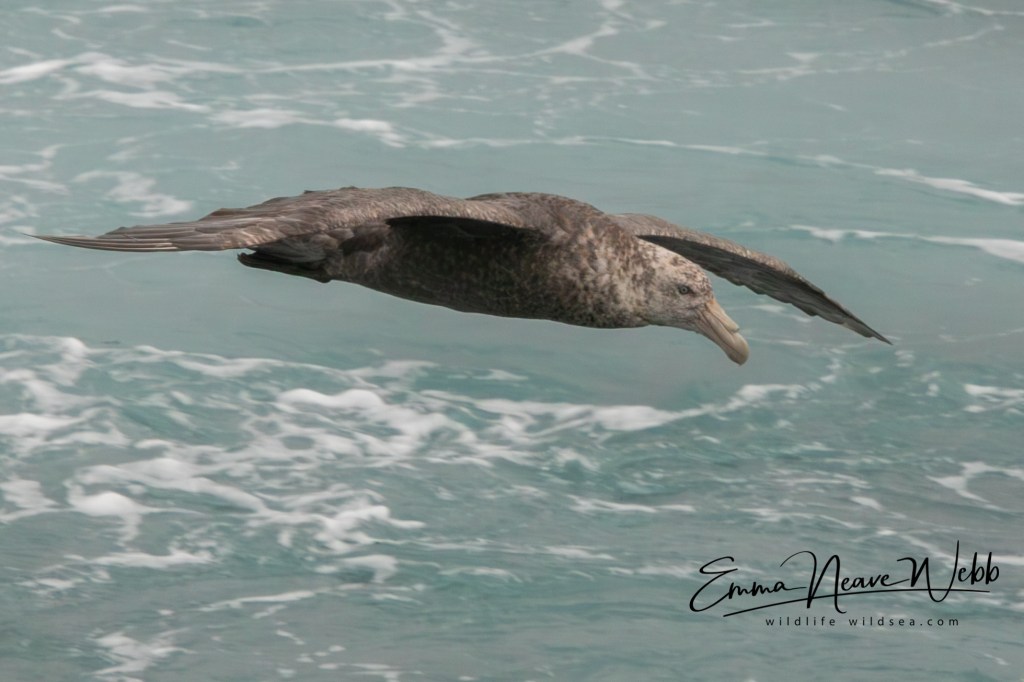
We were not alone in the water either. Throughout the afternoon, brief and tantalising glimpses of Peale’s dolphins, dusky dolphins and hourglass dolphins appeared alongside the ship, leaping cleanly before vanishing again as quickly as they had come. The hourglass dolphins in particular, with their striking bold black and white patterning, are genuine Southern Ocean specialists rarely seen north of the Antarctic Convergence, and each fleeting sighting felt like a small gift.
The Falkland Islands were still ahead. Antarctica was further still. Standing on that deck as the light faded over the South Atlantic, watching albatrosses work the wind off the stern, the excitement of what was coming was already difficult to contain. Though I will admit that excitement came with a side order of quiet apprehension. The Falkland Islands awaited, and we had no idea quite what we would find there.
More to come.
Wildlife Wild Sea
📍 South Atlantic Ocean, bound for the Falkland Islands


Leave a Reply