
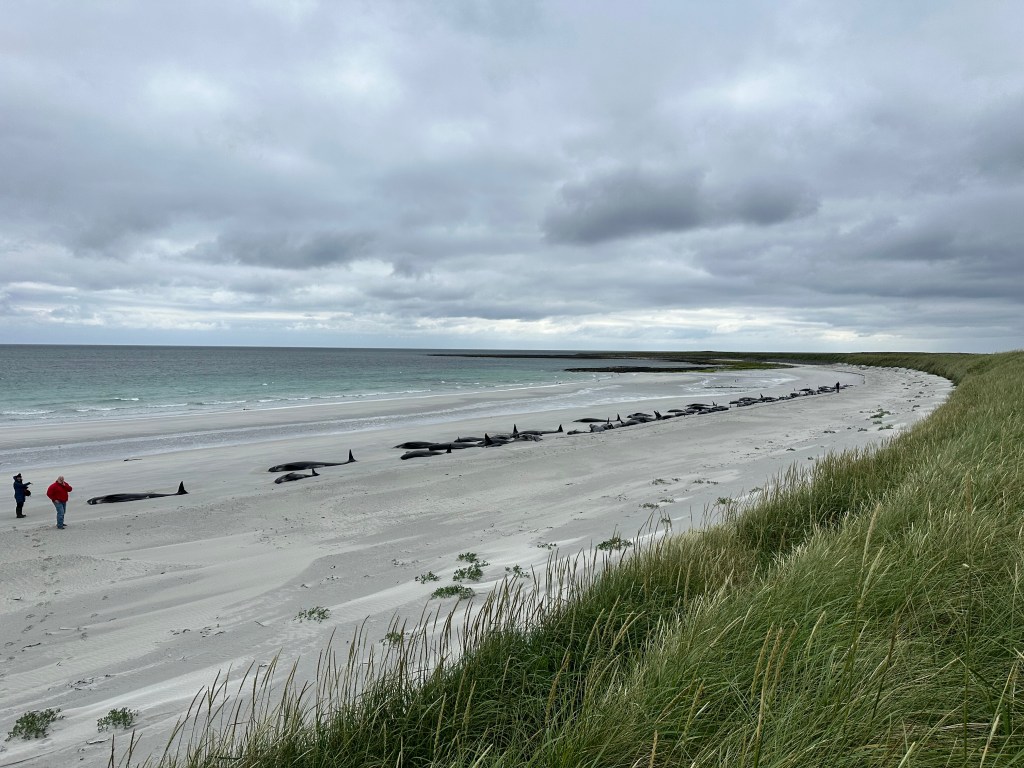
Today marks one year since the morning that changed everything for our little island community. July 11th, 2024 – the day we witnessed Scotland’s largest whale stranding on record for nearly 100 years, right here on the shores of Tres Ness, just about a mile from my house as the hooded crow flies.
Having been involved in strandings for over 20 years, initially as a volunteer with British Divers Marine Life Rescue (BDMLR) and the Scottish Marine Animal Strandings Scheme (SMASS) and more recently in a professional capacity as the Strandings Coordinator running the Strandings Initiative at the International Whaling Commission, I always knew this was going to happen at some point. But nothing prepares you for that moment you answer the phone, and someone tells you there’s a load of whales on the beach and some are still alive. That is the moment your heart drops and sheer panic sets in.
Whilst my career has given me the experience and expertise to understand what needed to happen – the protocols, the decisions, the science – nothing truly prepares you for when it happens on your own turf, almost within view of your office. All that theoretical knowledge suddenly became devastatingly real. Seventy-seven long-finned pilot whales – adults, juveniles, and calves – had beached themselves on our coastline. As incident controller and resident ‘expert’, I felt every bit of the weight of coordinating what would become the UK’s biggest mass stranding on record since 1927.
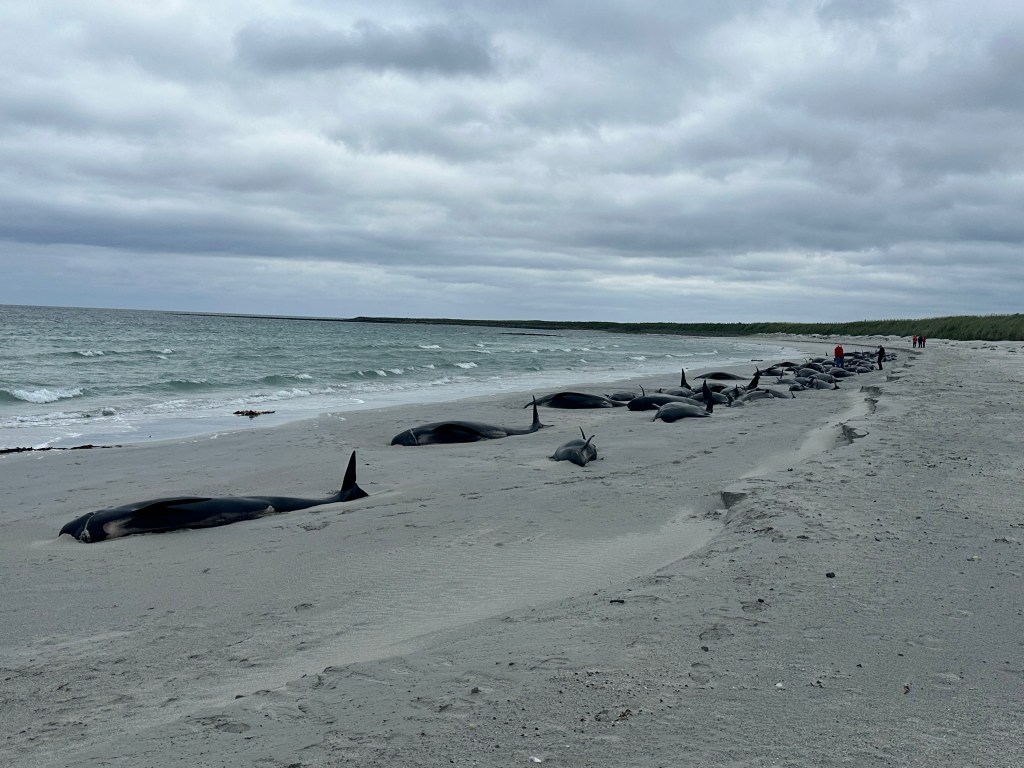
The hardest part was the helplessness and knowing there was absolutely nothing we could do whilst watching these animals fight for their lives. The pod had stranded overnight at high tide and become stuck firm in the soft sand in a jumble of bodies. It was too dangerous to try to right them as they lay on their sides, too close to each other for us to get near, let alone the fact that the largest animals weighed well over 2 tonnes. We simply didn’t have the manpower to move or right even the smaller animals we could safely reach. As the tide came back in, the feeling of despair increased as Russ and I watched the few whales still alive trying desperately to keep their blowholes above water and failing.
One of the biggest issues for stranded whales and dolphins is stranding or capture myopathy. A critical condition that develops when marine mammals are out of their natural aquatic environment. The crushing weight of their own bodies on land, combined with stress and compromised circulation, leads to severe muscle damage and toxic protein release into the bloodstream. This can cause kidney failure, respiratory distress, and death, even in animals that might otherwise survive. The rapid onset is why time is so critical in rescue efforts, and why welfare-based euthanasia is sometimes the most humane option. Knowing the animals had stranded at around 1am and been through a second high tide, the decision to euthanise the surviving 14 whales on welfare grounds was the only decision that could be made and one of the hardest conversations I’ve ever had. What I saw and heard over the next hours will stay with me forever.
But from tragedy came learning. The knowledge we gained was so invaluable that I was able to present this as a case study at a euthanasia workshop at the European Cetacean Society conference this year. If our experience can help shape better protocols for cetacean euthanasia and cetacean welfare going forward, then these whales’ final contribution to science will be truly meaningful.
In the following days, I was incredibly proud to be part of the team investigating this stranding. The response from the scientific community was extraordinary – experts from the Scottish Marine Animal Stranding Scheme, Cetacean Strandings Investigation Programme, Cornwall Marine Strandings Network, and various universities all came together to conduct the most comprehensive strandings investigations ever undertaken in the UK. Many of the team I have known and worked with for a number of years, but it was still a privilege to work alongside such dedicated and specialist team of researchers, pathologists, biologists and veterinarians, all united in understanding what had happened to this pod. We were also supported by volunteers from BDMLR, who provided crucial assistance both during the live stranding response and in gathering essential preliminary data before the scientific teams arrived.
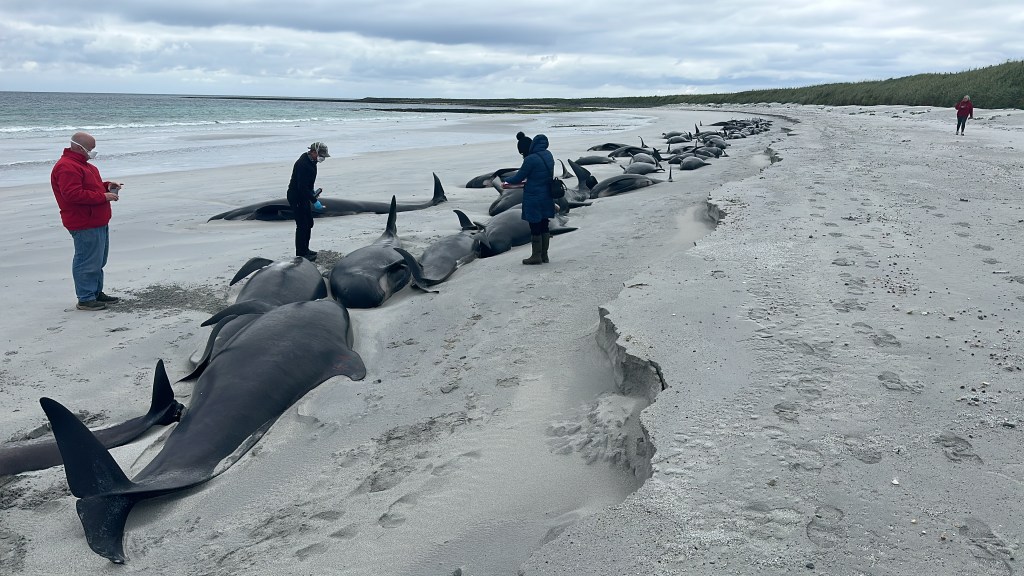
However, what fills me with the most profound gratitude is the extraordinary response of the Sanday community. When I put out that urgent call for 4×4 vehicles, chalk markers, and any help we could get, you showed up without question. You opened your homes to accommodate 17 visiting experts you didn’t know. You delivered food, helped document the event with photographs, drove tractors, were crucial to the clean-up operation and stood by us through one of the largest strandings responses seen in the UK.
You made the impossible possible. The logistics of coordinating such a massive operation on a remote island would have been impossible without the Sanday community. You turned what could have been a logistical nightmare into a testament to what people can accomplish when they come together.

To the people of Sanday – you are the real heroes of this story. Your compassion, practical help, and understanding during those overwhelming days made an unbearable situation bearable. You proved once again that when crisis strikes, our community rises to meet it with open hearts and willing hands.
The whales may be gone, but their memory lives on in our community’s response, in the scientific knowledge gained, and in the legacy they leave behind. Seventy-six whales now rest in burial sites across our island (thanks to the hard work of Sanday farmers). One remains near the beach, its skeleton hopefully destined for our Heritage Centre as a memorial. Plans are being made to create a suitable memorial that honours not only the whales but celebrates the amazing community in Sanday who came together to make this event more bearable.
One year on, I’m filled with sadness for the loss of those 77 magnificent creatures, but also with immense pride – pride in the scientific knowledge we gained and are still gaining from this stranding, pride in being part of something that will help future strandings response, and most of all, pride in calling Sanday home.
 Wildlife, Wild Sea
Leave a comment